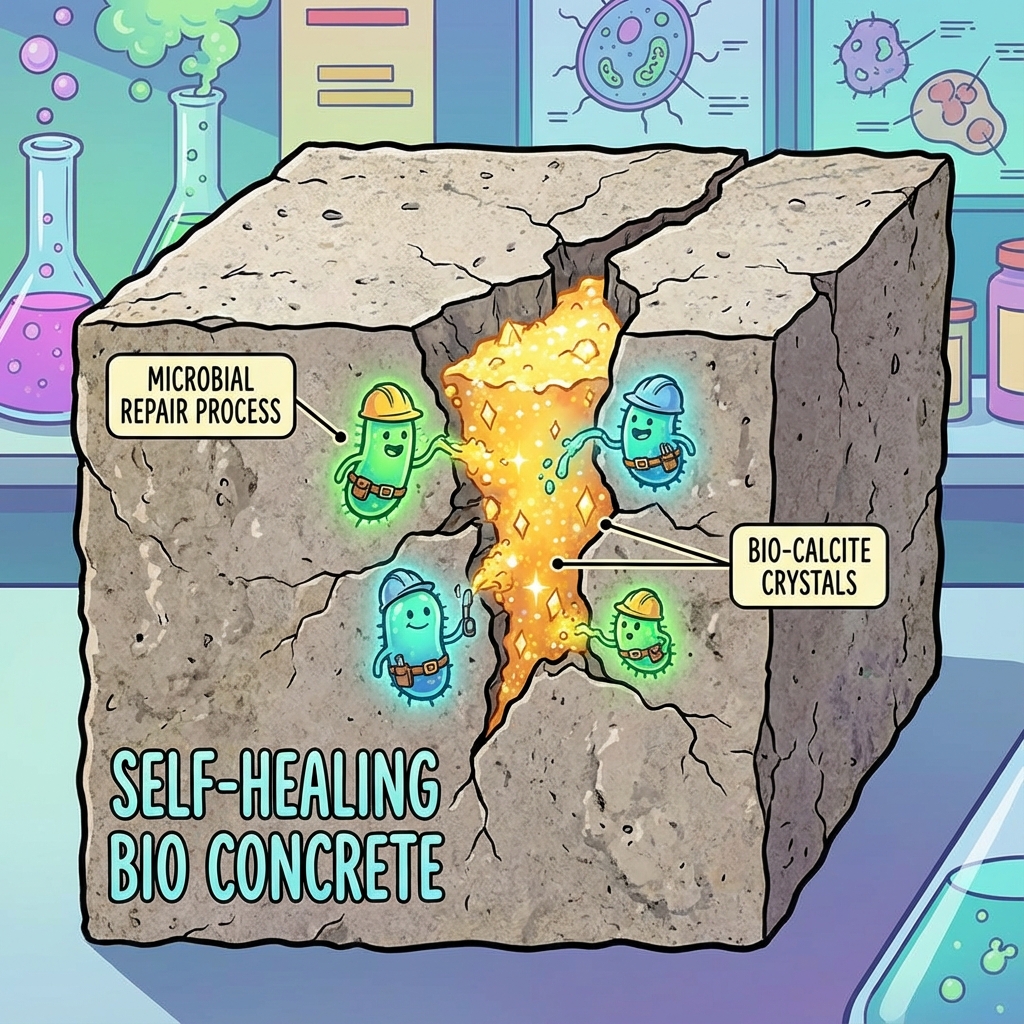
Concrete cracks; it's what it does. But in the Netherlands, a company called Basilisk (a TU Delft spinoff) is changing the rules. Their self-healing concrete, infused with limestone-producing bacteria, is now being deployed in real-world infrastructure—from a cycling bridge in Rotterdam to the loading pits at Schiphol Airport.
The "Sleeping Beauty" Bacteria
The technology uses standard *Bacillus* bacteria that lie dormant in the concrete for decades. When a crack forms and water enters, the bacteria wake up. They feed on polylactic acid (a food source mixed in) and excrete limestone, sealing cracks up to 1mm wide in a matter of weeks. This biological reflex effectively extends the lifespan of structures by decades.
The Economic Immunity
Infrastructure decay is a trillion-dollar global crisis. By using Basilisk's "Self-Healing Agent," engineers can reduce steel reinforcement (since the concrete protects itself better) and slash maintenance crews. While the initial material cost is roughly 20% higher, the total lifecycle cost is significantly lower—a massive win for sustainable city planning.
Nature as Co-Architect
This isn't theoretical. The A20 highway repair and the Groninger Forum parking garage are living proofs. We are moving from "static" materials that degrade to "active" materials that adapt. The city of the future won't just be smart; it will be alive.