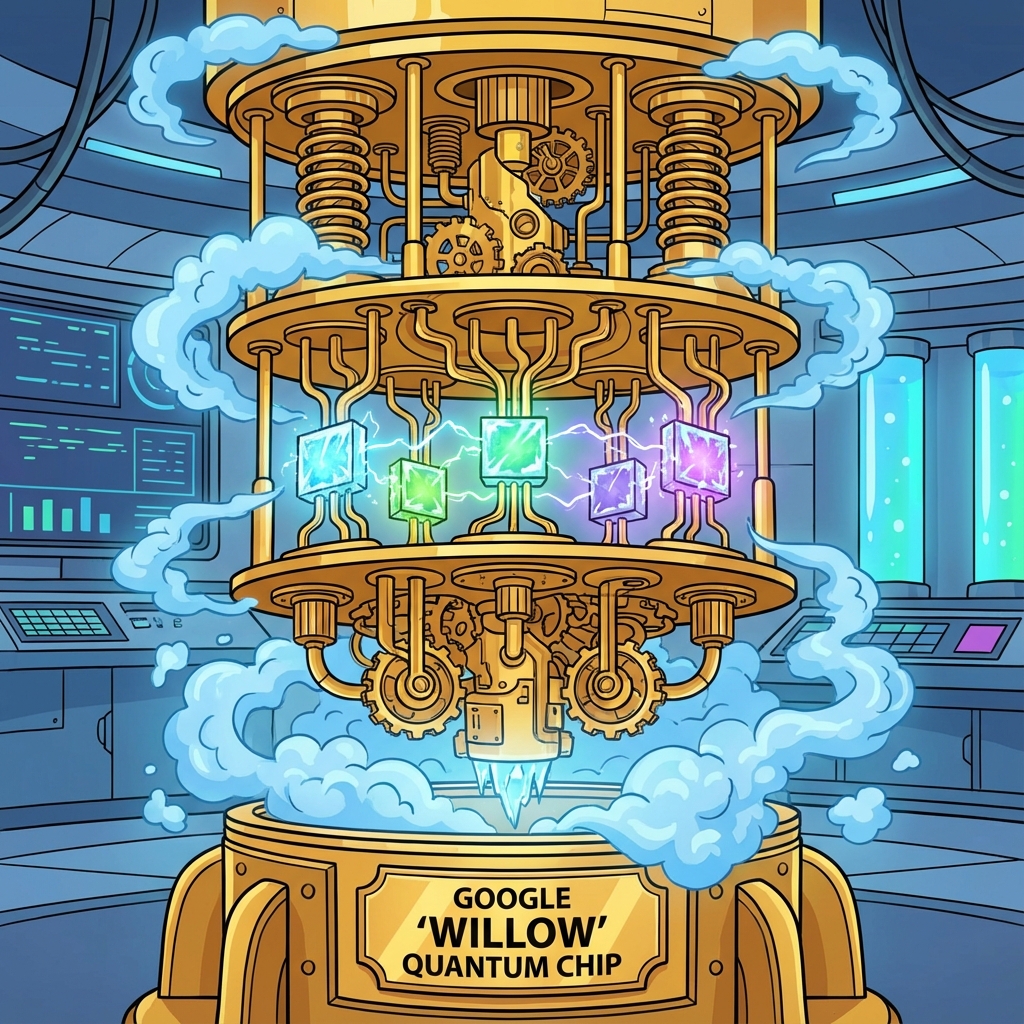
For decades, quantum computing was a "forever away" technology—always promising, never delivering. On December 9, 2024, the timeline collapsed. Google unveiled Willow, a 105-qubit chip that performed a benchmark calculation in 5 minutes. For context, the world's fastest supercomputer would need 10 septillion years (a number with 25 zeros) to match it. This isn't just a faster chip; it is the end of the "classical simulation" era.
The Simulation Wall is Broken
Why does this matter? Because until now, we could simulate small quantum systems on classical computers. Willow shatters that limit. We have crossed into territory where experimental verification is impossible because the math is too complex for any existing machine. This computational dominance means we can finally stop building "toys" and start modeling the chaotic, quantum reality of the universe itself—from high-temperature superconductors to efficient nitrogen fixation for fertilizer.
The Noise Barrier
The barrier to this moment was never just qubit count; it was noise. Quantum states are incredibly fragile. A stray photon or thermal fluctuation causes "decoherence," collapsing the calculation instantly. For years, adding more qubits just added more noise, making the computer less accurate. Engineering a chip that could scale without drowning in errors was considered the "sound barrier" of computing.
The Magic: Exponential Quiet
Willow’s breakthrough is a counter-intuitive masterpiece of error correction. Normally, as you scale up a system, errors compound. Willow inverts this rule: as the number of qubits increases, the error rate actually decreases exponentially. By weaving physical qubits together into logical clusters, the chip self-corrects in real-time. It doesn't just tolerate noise; it suppresses it. This "exponential suppression" is the holy grail that turns quantum computing from a physics experiment into a reliable engineering discipline.
The Transistor Moment
In 1947, the transistor replaced the vacuum tube, shrinking computers from room-sized heaters to pocket-sized miracles. Willow is the "transistor moment" for quantum. We are no longer fighting physics to keep a single qubit alive; we are scaling a stable architecture. The question is no longer "if" quantum computers will change the world, but "what" we will build with them first.