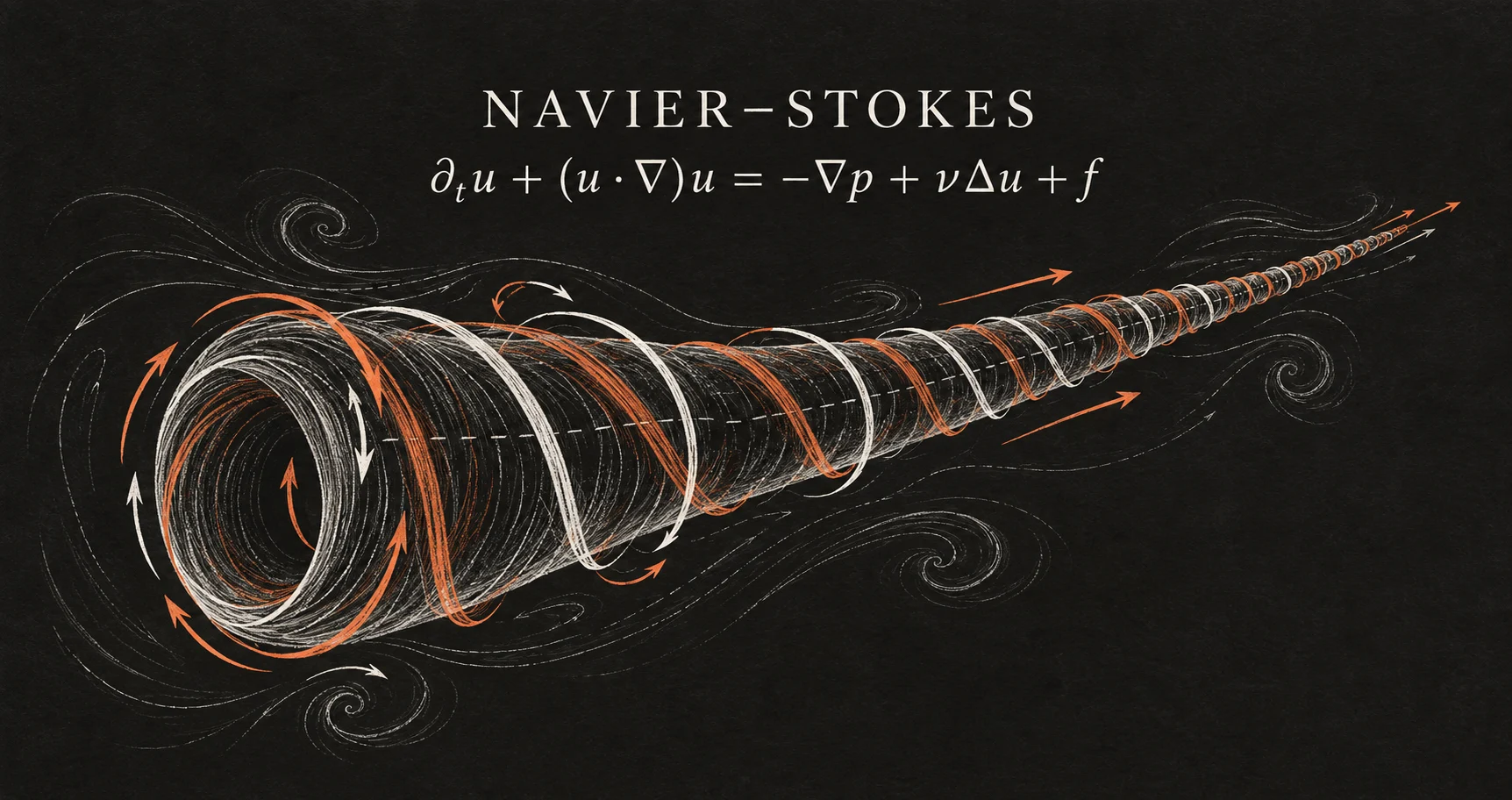
Can smoothly moving fluid develop infinite speed in finite time? On September 8, 2026, OpenAI announced a proof that this can happen in the three-dimensional incompressible Navier–Stokes equations with smooth external forcing. Clay acknowledged an apparent resolution on September 11, while pointing to its evaluation process. Announcement · Clay’s response.
When Smoothing Loses
The equations balance fluid acceleration, pressure, viscosity and external forces. Viscosity smooths velocity differences; nonlinear motion can concentrate them. The announced construction starts fluid at rest, then applies a smooth force. A contracting vortex develops unbounded velocity while total kinetic energy stays bounded. That is possible mathematically because the fastest motion occupies a shrinking region. Read the construction.
One Crucial Distinction
The claim addresses alternatives C and D of the Millennium problem, which allow suitable smooth forcing. It does not settle global regularity for unforced flow. The official formulation permits proving one alternative, so this distinction defines the result’s scope rather than excluding it from the prize problem. A singularity in the equations also does not mean ordinary water physically reaches infinite speed. Official problem statement.
What Happens Next
The authors released a manuscript and Lean formalizations for scrutiny. Clay’s statement is not a prize award: its rules include qualifying publication, a two-year wait and general mathematical acceptance. If validated, the construction could reveal a mechanism for failure under the stated assumptions and suggest new approaches to fluid problems.
Status checked September 14, 2026. This report summarizes the announced proof; we have not independently verified it.