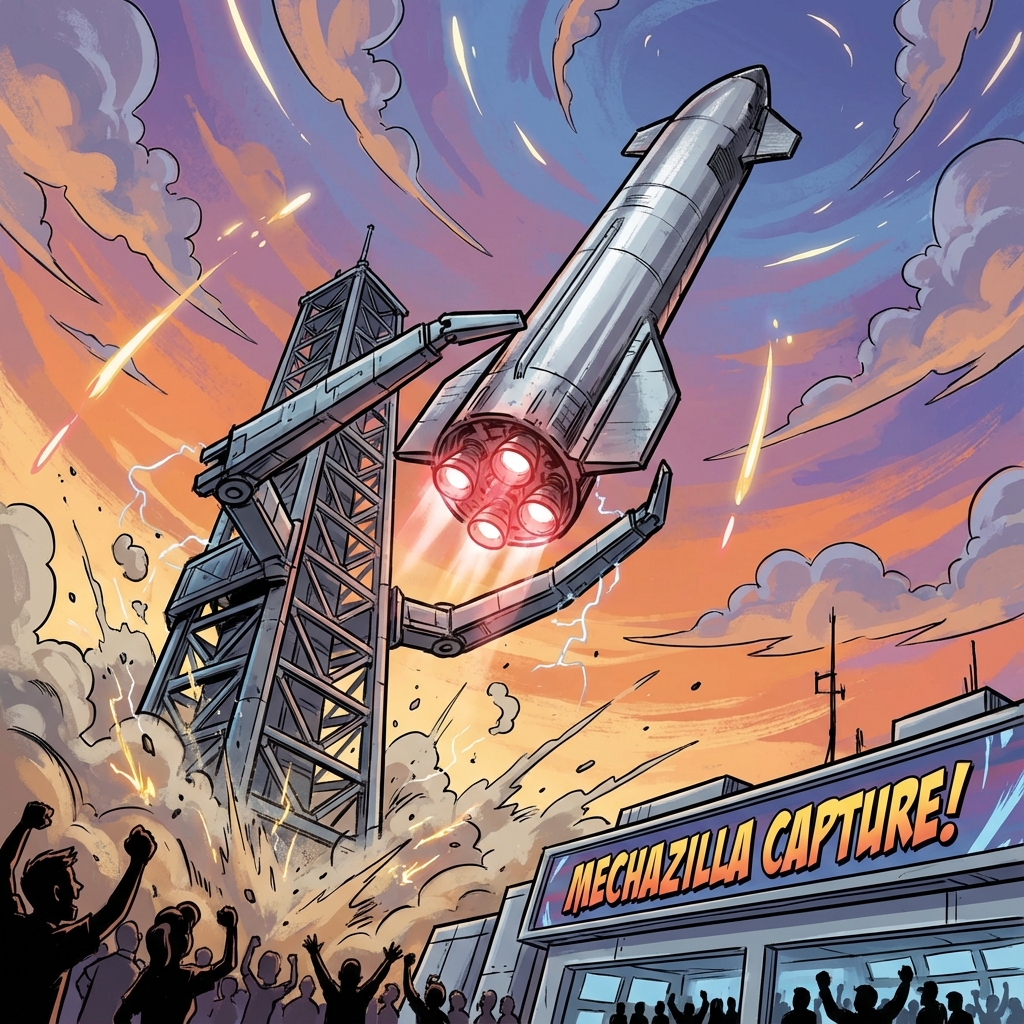
Physics said it was risky. Economics made it necessary. On October 13, 2024, the history of spaceflight fractured into "before" and "after." For decades, the defining image of rocketry was a disposable cylinder falling into the ocean—a billion-dollar trash heap. Flight 5 changed the default. SpaceX didn't just land a rocket; they caught it returning to the launch pad, effectively deleting the landing gear entirely.
Rapid Turnaround: The Airline Model
The true revolution isn't the spectacle; it's the operations. In the Falcon 9 era, a landed booster required weeks of transport from a drone ship, inspection, and refurbishment. The "catch" system places the booster directly back on the launch mount. In theory, it could be refueled and stacked with a new ship in hours, not weeks. This shifts rocketry from a slow, bespoke event into an airline-style operation where a single vehicle can fly multiple times a day. We have witnessed the first step toward a true spacefaring civilization.
The "No Legs" Equation
The tyranny of the rocket equation gives engineers no margin for error. Every kilogram of landing gear—hydraulics, legs, shock absorbers—is a kilogram of lost payload. Early designs for Starship included massive legs, but they were heavy and complex. Musk’s team asked a radical question: What if the tower caught the rocket? By moving the landing hardware from the vehicle to the ground (the "Mechazilla" tower), they saved tons of dry mass. This weight savings directly translates to more propellant and cargo for orbit, making the economics of a permanent Mars colony mathematically viable for the first time.
The Catch: Precision at Supersonic Speeds
The maneuver itself is a masterpiece of control theory. As the 250-foot Super Heavy booster falls from the edge of space, it is effectively a skyscraper diving belly-first. At the last moment, 13 Raptor engines reignite, flipping the vehicle vertical. This is where the "magic" happens. The booster must slow from supersonic speeds to a precise hover between two mechanical arms, all while battling variable atmospheric winds. The engines gimbal instantly, making micro-adjustments hundreds of times per second to keep the center of mass perfectly aligned. It’s not just landing; it’s threading a needle with a bomb.